Dining Room Buffet Decor Ideas: The Designer’s Guide
Walk into almost any dining room and you will find the same quiet casualty: a perfectly good buffet buried under a pile of mail, a lonely fruit bowl, or nothing at all. After a decade of styling dining rooms for clients, I can tell you the buffet is the most underused surface in the entire home — and the fastest one to transform.
Here is the good news. Great dining room buffet decor ideas are not about buying more things. They are about arranging a handful of well-chosen pieces with intention: something tall, something sculptural, something living, and enough empty space for the whole composition to breathe.
In this guide, I am walking you through the exact process I use in client homes — the styling formulas, the mirror math, the lamp placement, the seasonal swaps — so your buffet stops being a landing strip for clutter and starts anchoring the room. Every idea here works whether your dining room leans modern, farmhouse, traditional, or somewhere pleasantly in between.
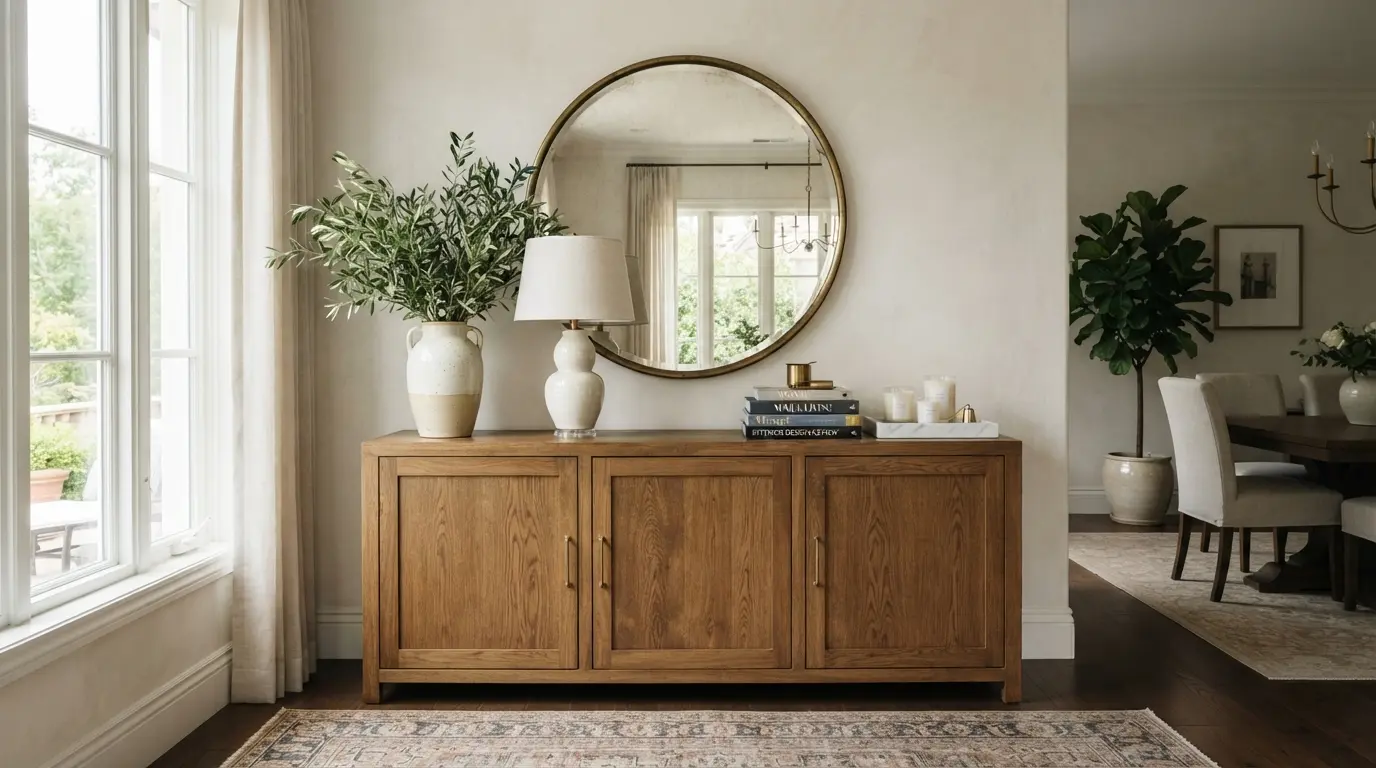
What Are the Best Dining Room Buffet Decor Ideas?The best dining room buffet decor ideas pair a large anchor piece — a mirror or artwork hung above — with layered accessories on the surface: a table lamp, a tall vase with greenery, a decorative tray, stacked books, and candles. Style in odd-numbered groupings, vary heights, and leave at least one-third of the surface empty. |
What Is a Dining Room Buffet, Exactly?
A dining room buffet — often called a sideboard or, when taller and legged, a credenza — is a long, low storage cabinet traditionally placed against a dining room wall. Historically it held serving dishes during meals, which is exactly how it earned its name. Today it does triple duty: storing linens, flatware, and serveware inside; serving food during gatherings; and acting as a permanent display surface the other 360 days of the year.
The distinctions matter less than decorators pretend. A sideboard typically sits lower with short legs or none at all. A buffet is usually taller. A credenza leans mid-century, with slim legs and sliding doors. For styling purposes, treat them identically: a horizontal surface between 34 and 38 inches high, crying out for a considered composition.
What makes the buffet unique among furniture is its visibility. Guests face it for the entire length of a dinner. It sits in the sightline from the kitchen, the hallway, often the front door. That visibility is precisely why buffet cabinet styling rewards effort so generously.
Why Buffet Styling Matters More Than You Think
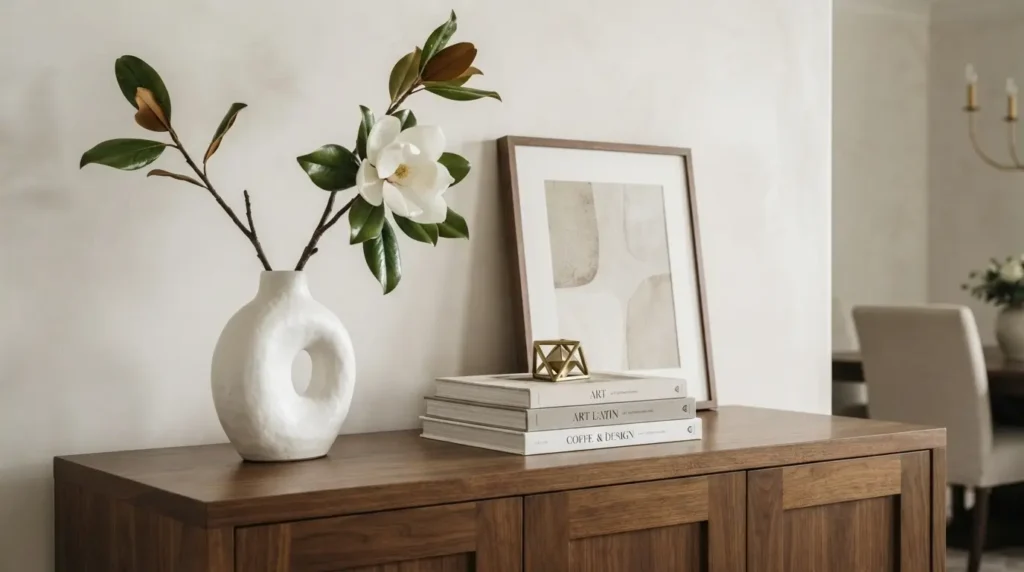
Dining rooms have a structural problem: nearly everything in them lives at one height. The table, the chairs, the seated guests — it is all horizontal mass below 40 inches. A styled buffet, crowned with a mirror or artwork and layered with lamps and vases, is often the only element pulling the eye upward. Remove it, and the room feels flat. Style it well, and the whole space gains architecture.
There is a practical argument too. In an era of open-plan living, the dining area is visible from everywhere. Your buffet table decor sets the tone for home entertaining before a single plate hits the table. And because the surface is compact — usually five to six feet — it is the rare decorating project you can complete in an afternoon and enjoy for years.
The Core Principles of Buffet Table Styling
Before we get to specific looks, learn the rules professionals actually use. Every beautiful buffet you have saved on Pinterest follows these five principles, whether the stylist admits it or not.
Anchor First, Accessorize Second
Start with the wall. A mirror, a large canvas, or a pair of framed prints hung above the buffet gives the composition a backbone. Accessories placed under a bare wall always look temporary; the same accessories under an anchor look curated.
The Rule of Three
Group objects in odd numbers — threes and fives read as natural and collected, while pairs read as formal and rigid. A classic trio: a lamp on the left, a stack of books with a small object in the center, a tall vase on the right.
Vary Height Deliberately
Every vignette needs a high point (lamp or tall branches), a mid point (vase, framed photo, candlesticks), and a low point (tray, bowl, book stack). If everything sits at the same height, the eye slides straight past.
Mix Texture, Repeat Color
Combine at least three materials — wood, ceramic, metal, glass, linen — but keep the palette to two or three colors pulled from the room. Texture creates interest; color repetition creates calm.
Protect the Negative Space
Leave roughly one-third of the surface empty. This is the hardest rule to follow and the one that most separates designer work from a crowded shelf. Empty space is not wasted space; it is what lets the objects you chose actually register.
Table 1: The Buffet Styling Formula at a Glance
| Layer | What It Is | Best Choices | Placement |
|---|---|---|---|
| Anchor | Wall piece above the buffet | Round mirror, large canvas, pair of prints | Centered, 6–8″ above surface |
| Height | Tallest surface element | Table lamp, branches in a floor-of-vase | One end, slightly forward |
| Mid layer | Medium-height objects | Vase, candlesticks, framed photo | Offset from center |
| Base layer | Low grounding pieces | Decorative tray, book stack, bowl | Front third of surface |
| Living element | Something organic | Eucalyptus, olive stems, potted plant | Anywhere the eye needs softness |
| Negative space | Deliberate emptiness | Nothing at all | At least one-third of the top |
Modern Dining Room Buffet Decor Ideas
Modern buffet styling trades quantity for silhouette. Choose a sleek buffet cabinet — walnut with flat fronts, or a matte lacquer piece — and limit the surface to three or four sculptural objects with strong shapes: an oversized ceramic vessel, an abstract sculpture, a single dramatic stem in a glass vase.
- Hang one large-scale abstract canvas rather than a gallery wall — modern rooms reward restraint.
- Choose lamps with clean geometry: a globe base, a slim column, or an arched brass task lamp.
- Keep the palette tonal — warm whites, charcoal, oak — and let one object carry an accent color.
- Use a low black or travertine tray to corral small items into a single visual block.
The mistake to avoid in modern dining room decor is coldness. One organic element — a branch, a rough-glazed pot, a linen runner — keeps the composition from feeling like a showroom.
Farmhouse Buffet Decor That Feels Collected, Not Costumed
Farmhouse buffet decor works best when it looks inherited. Start with a wood buffet with visible grain — reclaimed pine, whitewashed oak, or a painted piece with gently worn edges. Then layer in objects that feel found: stoneware crocks, a vintage bread board leaned against the wall, an aged brass candlestick trio, a pitcher of fresh or dried flowers.
- Lean a weathered window frame or antique mirror instead of hanging it for an easy, relaxed anchor.
- Use galvanized metal or woven seagrass trays to add rustic texture without more wood.
- Style a lamp with a pleated or linen shade — farmhouse rooms need soft, warm light.
- Add height with dried wheat, cotton stems, or foraged branches in a chunky crock.
Resist the urge to add words. Signs reading “Gather” or “Farm Fresh” date a room instantly. Let the materials — wood, stone, iron, linen — do the talking, and your rustic dining room will read timeless rather than themed.
Luxury Buffet Styling for an Elegant Dining Room
Luxury dining room styling is about weight and finish. Every object on the buffet should feel substantial: a marble tray rather than melamine, crystal or heavy smoked-glass vases, lamps with stone or cast-brass bases, hardcover art books from Assouline or Phaidon stacked two or three high.
The anchor deserves the biggest investment. An antiqued or beveled mirror in a gilded frame doubles candlelight beautifully during dinner parties — the oldest trick in formal dining rooms, and still the best. Flank it with a pair of matching lamps for symmetry; luxury styling is the one aesthetic where pairs outperform odd numbers.
Finish with an elegant centerpiece idea kept in reserve: a footed bowl or a lidded ginger jar that can migrate to the dining table when guests arrive, then return to the buffet after.
Minimalist Buffet Designs
Minimalist buffet styling is an exercise in editing. Choose no more than three objects, give each one room, and make every piece earn its place through form or function. A single handmade vessel, a small framed work leaned against the wall, and a candle — that can be the entire composition, and in a quiet, neutral dining room it will look intentional rather than unfinished.
The secret is quality of surface. When you display less, the buffet itself becomes decor: choose one with beautiful veneer, interesting hardware, or sculptural legs. And keep the interior ruthlessly organized, because minimalist styling collapses the moment the doors open onto chaos.
Traditional Dining Room Buffet Ideas
Traditional styling embraces symmetry and ceremony. Center a framed mirror or classical landscape above the buffet, place matching lamps or candlestick pairs at each end, and fill the middle with a footed compote, a porcelain tureen, or a floral arrangement in a classic urn shape.
Display your good things. Traditional buffet decorating ideas are the natural home for heirloom silver, blue-and-white porcelain, and crystal decanters that spend the rest of the year hidden in cabinets. A runner in linen or a subtle damask protects the surface and adds a finished, layered quality that suits formal rooms.
Choosing the Right Buffet Cabinet
The best styling cannot rescue the wrong piece. Size first: a buffet should span one-half to two-thirds of its wall, sit 34 to 38 inches high, and leave at least 36 inches of clearance to the dining table so chairs and traffic move freely. Then choose the material that fits your life, not just your aesthetic.
Table 2: Buffet Cabinet Material Comparison
| Material | Look & Feel | Durability | Care Level | Best For |
|---|---|---|---|---|
| Solid oak / walnut | Warm, substantial, ages beautifully | Excellent | Low — occasional oiling | Long-term investment, most styles |
| Reclaimed pine | Rustic, characterful, visible grain | Good — dents add charm | Low | Farmhouse and rustic dining rooms |
| Painted MDF / lacquer | Crisp, color-forward, budget-friendly | Moderate — chips show | Medium | Modern and contemporary rooms |
| Marble or stone top | Elegant, cool, high-end | Very good — can etch | Medium — sealing required | Luxury dining rooms, serving-heavy homes |
| Rattan / cane fronts | Light, textural, relaxed | Moderate | Low | Coastal and organic modern spaces |
| Glass-front cabinet | Displays china, adds depth | Good | Medium — fingerprints | Traditional rooms, collectors |
Considering built-in buffet ideas? A wall-to-wall built-in with lower cabinets and open shelving above delivers enormous storage and a custom look, and its counter styles exactly like a freestanding piece — same formula, longer canvas.
Decorating with Table Lamps
If I could add only one thing to every client’s buffet, it would be a lamp. Overhead dining light is flat and often harsh; a table lamp at buffet height adds a warm, low glow that makes evening meals instantly more atmospheric. Scale it generously — 24 to 32 inches tall for a standard buffet — and place it at one end, not dead center.
- Use a pair of lamps for symmetry in traditional and luxury rooms; a single lamp for modern and casual spaces.
- Choose warm bulbs (2700K) on a dimmer or smart plug for effortless dinner-party lighting.
- Let the shade material echo the room: linen for soft styles, pleated for traditional, paper or metal for modern.
Mirrors Above a Buffet: Getting the Size Right
A mirror above the buffet brightens the dining room, bounces window light, and doubles every candle at the table. The math matters: the mirror should measure one-half to three-quarters of the buffet’s width and hang with its bottom edge six to eight inches above the surface — low enough to feel connected, high enough to clear your lamps.
Table 3: Mirror Size Guide for Dining Room Buffets
| Buffet Width | Ideal Mirror Width | Round Mirror Diameter | Hanging Height Above Surface |
|---|---|---|---|
| 48″ (4 ft) | 24–36″ | 30–34″ | 6–8″ |
| 60″ (5 ft) | 30–45″ | 34–38″ | 6–8″ |
| 72″ (6 ft) | 36–54″ | 38–42″ | 6–8″ |
| 84″+ (7 ft+) | 42–63″ or a pair | 42″+ or two rounds | 6–8″ |
Round mirrors soften rooms full of straight lines; arched mirrors add height to low-ceilinged spaces; antiqued glass flatters traditional and luxury schemes. Whatever the shape, hang it — leaning oversized mirrors on a buffet crowds the styling surface you worked so hard to clear.
Artwork Placement Above the Buffet
Prefer art to mirrors? Follow the same proportions: total artwork width at one-half to three-quarters of the buffet, hung six to ten inches above the surface. A single oversized canvas reads modern and confident. A pair of vertical prints suits traditional symmetry. A leaning, layered arrangement — large piece behind, smaller frame overlapping in front — feels collected and relaxed.
Wall art above the buffet is also your color cue. Pull one or two hues from the artwork into your vases, candles, and books below, and the whole vignette snaps together as if it were planned by a professional. Because now it was.
The Working Layer: Trays, Vases, Candles, Books, and Greenery
Decorative Trays
A tray is the stylist’s secret weapon. It corrals small objects — matches, coasters, a candle, a tiny dish — into one deliberate visual block, and it lifts instantly off the buffet when you need serving space. Choose marble or brass for luxury schemes, wood or woven seagrass for casual rooms, and lacquer or travertine for modern ones.
Vases and Floral Arrangements
Vases and greenery are the fastest refresh in decorating. Keep two or three vase shapes on rotation: one tall (20 inches or more) for branches, one medium for market flowers, one small for single stems. Faux olive, eucalyptus, and magnolia have improved dramatically — mix one real element in and no one will ever check.
Candles and Candle Holders
Candlesticks add vertical rhythm without bulk. Style them in staggered-height trios — brass for warmth, black metal for contrast, wood for farmhouse ease. Pillar candles on a tray or in hurricane sleeves bring the glow down to surface level for dinner parties.
Books and Decorative Objects
Stack two to four hardcovers horizontally and top them with a small sculptural object — a bowl, a shell, a ceramic figure. Books add instant intellect and, more practically, they are the easiest way to give a short object the extra three inches of height it needs.
Greenery and Indoor Plants
Every buffet needs one living thing. A trailing pothos softening the cabinet’s edge, a potted fern, or simply fresh stems in water — organic shapes break up all the hard geometry and make the vignette feel alive rather than staged.
Layering Decor Correctly and Coordinating Color
Layering is depth, not clutter. Work back to front: the anchor on the wall, tall items just in front of it, medium pieces in the middle ground, and low trays or books at the front edge. Overlap silhouettes slightly — a lamp partially in front of the mirror’s edge, a small frame tucked in front of a larger one — so the composition has dimension from every seat at the table.
Table 4: Decor Item Placement Guide
| Zone | Depth Position | Ideal Items | Height Range |
|---|---|---|---|
| Backdrop | On the wall | Mirror, canvas, leaning art | Above surface |
| Back row | Rear third of top | Lamps, tall vases, branches | 18–32″ |
| Middle row | Center third | Candlesticks, framed photos, jars | 8–18″ |
| Front row | Front third | Trays, book stacks, low bowls | 1–8″ |
| Cabinet base | Floor beside buffet | Large plant, basket, floor vase | Varies |
For color coordination, use the 60-30-10 rhythm in miniature: 60 percent of your objects in the room’s dominant neutral, 30 percent in a secondary tone like wood or brass, and 10 percent in one accent pulled from your art, rug, or seat cushions. A neutral dining room can absorb bolder accents on the buffet than anywhere else, because the surface is small and easily edited.
Styling Open Shelves and Small Dining Rooms
Open Shelves and Glass-Front Buffets
Open shelving above or within a buffet should follow a loose grid: alternate stacked items with vertical ones, repeat a material on every shelf so the eyes connect them, and keep 30 to 40 percent of each shelf empty. Everyday white dishware, glass, and one wood tone is a combination that never fails.
Small Dining Rooms
In tight spaces, shrink the furniture, not the styling. A narrow 12-to-14-inch-deep console table decorated like a buffet delivers the same effect without stealing floor space. Hang a mirror rather than art to visually double the room, keep the surface to one lamp, one vase, and one tray, and choose a leggy, open-based piece so light flows underneath.
Seasonal Buffet Decor and Holiday Styling
The buffet is the ideal seasonal stage — far better than the dining table, which needs clearing for every meal. Keep your anchor, lamps, and trays constant year-round, and swap only the botanicals, candles, and one or two accent objects each season. Fifteen minutes, four times a year.
Table 5: Seasonal Buffet Decorating Checklist
| Season | Botanicals | Candle Palette | Accent Swap |
|---|---|---|---|
| Spring | Tulips, cherry blossom, budding branches | Soft white, pale green | Pastel ceramics, nest or egg accents |
| Summer | Hydrangea, olive stems, citrus in a bowl | White, sea-glass blue | Woven tray, coastal accents, linen runner |
| Autumn | Dried wheat, eucalyptus, mini pumpkins | Amber, rust, cream | Bronze objects, plaid or velvet runner |
| Winter / Holiday | Cedar garland, pine, red berries, paperwhites | Deep red, gold, ivory | Mercury glass, brass, heirloom serving pieces |
For holiday buffet styling specifically, think in layers of light: a cedar garland draped along the back edge, candlelight at two heights, and metallics — mercury glass, brass, a gilded mirror — to multiply every flame. The buffet also earns its name in December: leave the front half clear for the dessert spread, and style only the back rail.
Budget-Friendly Dining Room Buffet Decor Ideas and DIY Projects
A designer-level buffet does not require a designer budget. Thrift stores are full of brass candlesticks, ginger jars, hardcover books, and solid-wood frames for a few dollars each. Foraged branches cost nothing and outperform most store-bought stems. And paint remains the highest-return DIY in decorating: a dated oak buffet in a deep, moody color with new hardware becomes the best piece in the room for the price of a quart and a weekend.
Table 6: Budget vs Luxury Buffet Styling
| Element | Budget Choice (Under $30) | Luxury Choice ($150+) | Where It Shows |
|---|---|---|---|
| Anchor | Thrifted framed mirror, repainted | Antiqued gilded or beveled mirror | High — invest here first |
| Lamp | Secondhand base with a new shade | Alabaster, ceramic, or cast-brass lamp | High — light quality is visible |
| Vase | Glass vase with foraged branches | Handmade ceramic or crystal vessel | Medium |
| Tray | Woven seagrass or painted wood | Marble, travertine, or brass tray | Medium |
| Books | Thrifted hardcovers, jackets removed | Coffee-table volumes (Assouline, Phaidon) | Low — styling matters more |
| Botanicals | Grocery stems, dried wheat | Weekly florist arrangements, orchids | Low — fresh beats expensive |
- Paint-and-hardware makeover: sand lightly, prime, roll two coats of cabinet enamel, and swap in unlacquered brass pulls.
- DIY antiqued mirror: age an inexpensive mirror’s edges with a spray-and-vinegar technique for instant vintage character.
- Book-jacket edit: remove glossy dust jackets to reveal quiet cloth spines that photograph beautifully.
- Tray upgrade: add small brass corner brackets and handles to a plain wooden tray from a craft store.
- Dried arrangement: bundle grocery-store wheat or bunny-tail grass in a thrifted crock — it lasts a full season.
Dining Room Trends 2026: What’s Shaping Buffet Styling Now
This year’s contemporary dining room leans warm and tactile. Expect rich wood tones — walnut, smoked oak — replacing cool grays; plaster-finish and travertine accessories; chrome and polished nickel returning alongside brass; and sculptural, chunky ceramics with visible hand-of-the-maker texture.
The bigger shift is philosophical: rooms styled to look collected over time rather than bought in one order. Vintage and heirloom pieces mixed with new, quiet color-drenched walls behind the buffet, and fewer, better objects. If you take one 2026 cue, make it this — edit your buffet down, then add one genuinely old thing.
Expert Decorating Tips From the Field
- Style at eye level, then sit down. Check the vignette from a dining chair — that is how guests will actually see it.
- Photograph your buffet. The camera flattens the scene and exposes imbalance your eye forgives in person.
- Buy the lamp first. Lighting sets the mood; accessories only decorate it.
- Repeat one metal, one wood tone, and one accent color across the whole surface for instant cohesion.
- Odd numbers for casual rooms, mirrored pairs for formal ones — choose a language and stay in it.
- Leave landing space. If the buffet serves food monthly or more, keep one end permanently clear.
- Rotate, don’t accumulate. Store off-duty decor in the buffet itself and swap seasonally instead of adding.
Common Buffet Decorating Mistakes to Avoid
- Undersized everything: a 10-inch mirror and bud vase on a six-foot buffet disappear. Scale up.
- The flat line: five objects of identical height read as clutter, not styling. Vary elevation deliberately.
- No anchor: accessories under a bare wall always look like they are waiting to be put away.
- Overcrowding: covering every inch erases the composition. Protect that empty third.
- Clashing metals and mixed color stories: more than two metals or three colors turns curated into chaotic.
- Blocking function: styling so dense the buffet can never actually serve a buffet defeats the furniture’s purpose.
- The mail pile: no vignette survives a clutter magnet. Give paperwork a home anywhere else.
Frequently Asked Questions
What do you put on a dining room buffet?
Layer five elements: an anchor on the wall above (mirror or artwork), one or two table lamps for height, a vase with fresh or faux greenery, a decorative tray to corral small objects, and a low stack of books or a bowl. Vary the heights, group items in odd numbers, and leave about one-third of the surface empty so the arrangement can breathe.
How big should a mirror be above a buffet?
Choose a mirror one-half to three-quarters the width of your buffet — roughly 30 to 45 inches wide for a standard five-foot piece. Hang it so the bottom edge sits six to eight inches above the surface. For round mirrors, a 34-to-38-inch diameter suits most buffets and softens the room’s straight lines beautifully.
Should a buffet be taller or shorter than the dining table?
A buffet should stand taller than the dining table — typically 34 to 38 inches high against a standard 30-inch table. That extra height keeps it comfortable for serving while standing and helps it read as its own architectural moment in the room. Leave at least 36 inches of clearance between the buffet and the table for chairs and traffic.
How do I decorate a buffet on a budget?
Shop secondhand first: thrifted brass candlesticks, ginger jars, hardcover books, and solid-wood mirrors deliver designer texture for a few dollars each. Add foraged branches or grocery-store stems in a simple glass vase for a living element. If the buffet itself is dated, a coat of quality cabinet paint and new hardware transforms it for under fifty dollars.
Conclusion: Bringing Your Dining Room Buffet Decor Ideas to Life
A beautifully styled buffet is one of the highest-return projects in decorating: a single surface, a handful of objects, and an afternoon of work that changes how the entire dining room feels. The formula holds across every style — anchor the wall, build height with a lamp, layer the middle, ground the front with a tray, add something living, and protect the empty space.
Start where you are. Clear the surface completely, shop your own home first, and rebuild with intention using the dining room buffet decor ideas in this guide. Sit at the table, look at what you have made, and adjust. That last five percent of nudging and editing is where a nicely arranged shelf becomes a room’s quiet centerpiece — and it is a skill you now own.