20 Best Warm Aesthetic Cozy Bedroom Ideas 2026
Two bedrooms can share the same beige paint, the same oak nightstand and the same linen duvet, and only one of them will feel like somewhere you want to spend a slow Sunday morning. After more than a decade of styling bedrooms for clients, I can tell you the difference almost never comes down to budget.A warm aesthetic cozy bedroom is not a shopping list. It is a set of relationships — between the color temperature of your bulbs and the undertone of your walls, between the height of your headboard and the scale of your window, between how many textures are in the room and how many things are competing for your attention.
Most rooms that read as cold are not cold because of color. They are cold because every surface is smooth, the entire room is lit from one ceiling fixture, and everything matches a little too perfectly. Beige accessories cannot fix any of that. Warmth is built from seven things working at once: lighting, color, texture, furniture, bedding, personal details and visual balance. Pull any one of them out and the room drifts back toward showroom territory, pleasant, photogenic, and somehow not comfortable.
How Do You Create a Warm Aesthetic Cozy Bedroom?
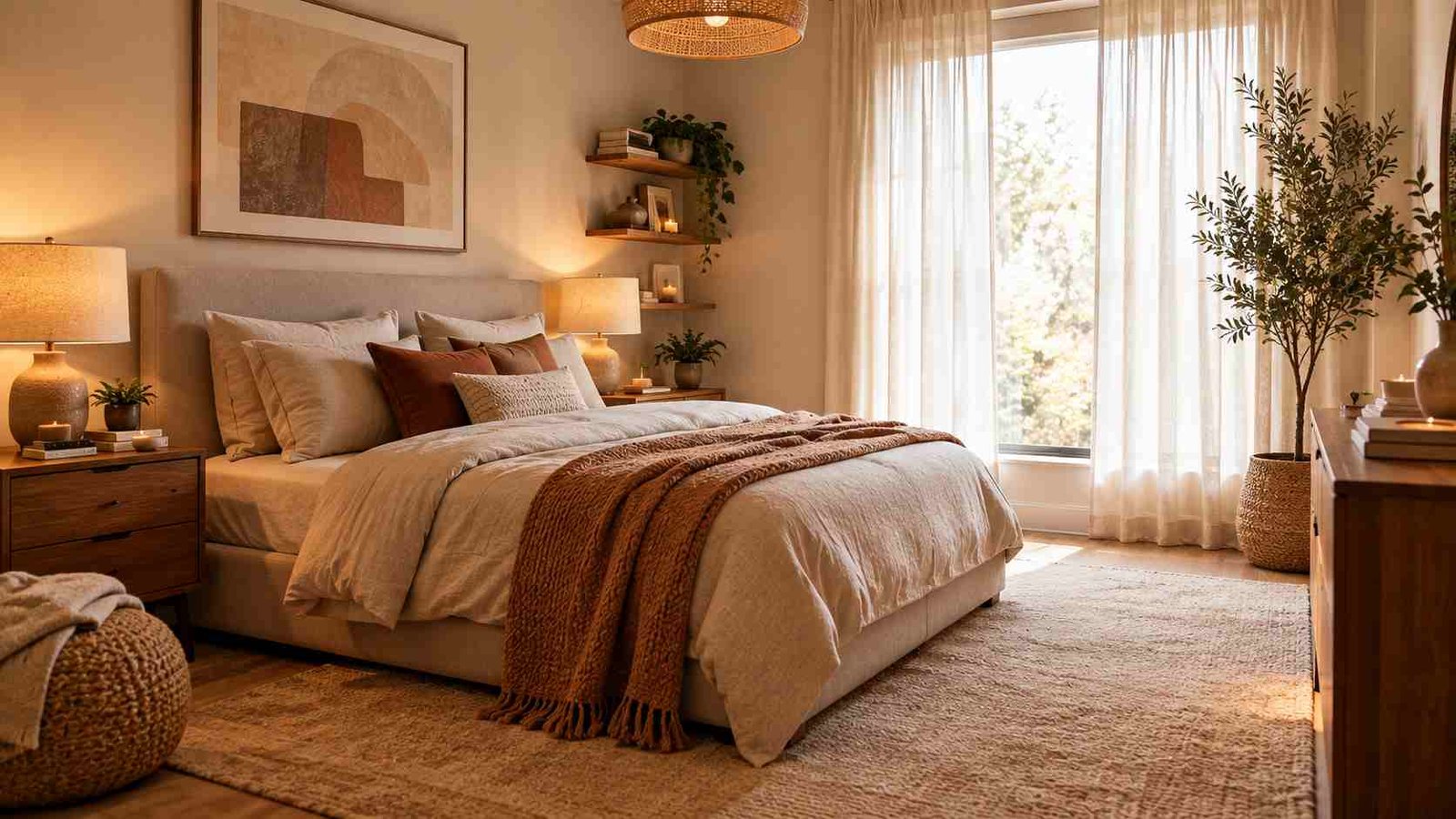
Start with a warm neutral wall colour such as cream, beige or soft terracotta, then light the room with three or more warm-white sources at eye level instead of one ceiling fixture. Layer bedding in linen, cotton and wool, add wooden furniture and a soft rug, and finish with plants, books and personal objects.
What Actually Makes a Bedroom Feel Warm and Cozy
Cosiness is a sensory response, not a style. Your eye reads a room as warm when it finds soft edges, low contrast, light that falls at low and mid heights, and materials that look like they would feel good against skin. Every technique in this guide is a way of feeding your eye more of that information.
Warmth Is a Temperature Decision Before It Is a Colour Decision
You can paint a room the most beautiful caramel on the fan deck and ruin it with 5000K bulbs. Cool light strips the red and yellow out of warm pigments, leaving beige looking grey and terracotta looking dusty and flat.
Before buying a single cushion, check what is in your light fittings. Bulbs between 2200K and 2700K are the working range for a warm cozy bedroom aesthetic. Anything above 3000K belongs in a kitchen or a garage, not above a bed.
The Five-Layer Rule I Use in Every Bedroom.
- Ground layer — flooring and rug. This sets the base warmth of the room and softens acoustics, which matters more than people expect.
- Colour layer — walls, large curtains and the headboard. These are the surfaces your eye reads first from the doorway.
- Light layer — a minimum of three sources at different heights, all on warm bulbs.
- Textile layer — bedding, throws, cushions and upholstery, in at least three different weaves.
- Personal layer — books, art, plants, ceramics, photographs. The proof that a person lives here.
How to Create a Warm Aesthetic Cozy Bedroom, Step by Step.
- Empty the room mentally. Note which direction the windows face — north-facing rooms need warmer pigments and warmer bulbs than south-facing ones.
- Fix the light before the colour. Replace every bulb with 2700K warm white and add a lamp at bedside height. Live with it for two evenings.
- Choose your wall colour against the new light, not against a shop swatch. Paint a large sample board and move it around the room at different hours.
- Set the bed as the anchor. Headboard, mattress height and bedding weight decide the visual centre of gravity for everything else.
- Add the rug, then the curtains. Both should be generous. Both are structural, not decorative.
- Layer bedding in three weights — a sheet, a duvet or quilt, and a throw with obvious texture.
- Bring in wood. One piece of genuine timber does more for warmth than three beige cushions.
- Introduce a second light source at a different height, then a third at a lower one.
- Add greenery, art and personal objects last, editing as you go.
- Take a photograph from the doorway. The camera flattens the room and shows you exactly where the balance is off.
Choosing a Warm Bedroom Colour Palette
- Warm Neutrals: Cream, Beige and Warm White
- Brown, Tan and Caramel
- Terracotta and Muted Earth Tones
- Soft Green and Dusty Rose
Warm Bedroom Color Palette Comparison
| Colour | Undertone | Best Used On | Pairs Well With | Works Best In |
|---|---|---|---|---|
| Cream | Yellow / soft gold | Walls, bedding, curtains | Walnut, caramel, olive, brass | Any room; especially north-facing |
| Beige | Grey-yellow / greige | Walls, rugs, upholstery | Chocolate, cream, terracotta | Rooms needing a quiet base |
| Warm White | Warm neutral | Ceilings, trim, small rooms | Every warm tone | Small or low-ceilinged bedrooms |
| Terracotta | Red-orange, chalky | Accent wall, rug, ceramics | Cream, olive, oak, brass | Bright rooms with good daylight |
| Caramel | Amber / honey | Throws, headboards, leather | Cream, chocolate, sage | Mid-sized rooms lacking depth |
| Chocolate Brown | Deep red-brown | Headboards, joinery, curtains | Oatmeal, cream, dusty rose | Larger rooms; grounding a scheme |
| Olive Green | Muted yellow-green | Walls, bedding, curtains | Cream, tan, rattan, black | Rooms with a garden outlook |
| Dusty Rose | Brown-leaning pink | Cushions, bedding, art | Camel, cream, aged brass | Romantic and evening-use rooms |
Creating a Cozy Atmosphere With Layered Lighting
If you change only one thing after reading this guide, change the lighting. Nothing else delivers as much warmth for as little money, and nothing else undoes good decorating as thoroughly when it is wrong.
The principle is simple: replace one bright source at ceiling height with several soft sources at different heights. Your eye reads scattered pools of low light as intimate; it reads flat overhead light as functional.
Bulb Temperature, Brightness and Dimming
Warm bedroom lighting starts with the bulb, not the fixture. Look for 2700K for general use and 2200K for bedside and accent lamps, which mimics candlelight and flatters both skin and timber.
Brightness matters as much as colour. A bedside lamp rarely needs more than 400 to 450 lumens. Dimmable bulbs paired with a smart plug or an inline dimmer cost very little and let one room shift from getting-ready bright to wind-down low.
Bedroom Lighting Guide
| Light Source | Layer | Ideal Bulb | Best Placement | What It Does for the Room |
|---|---|---|---|---|
| Bedside lamps | Task / mid | 2200–2700K, 400–450lm | Shade base at shoulder height when seated in bed | Creates the primary warm glow and symmetry |
| Floor lamps | Ambient / tall | 2700K, dimmable | Behind a chair or in a dead corner | Fills empty vertical space and lifts dark corners |
| Wall sconces | Task / mid | 2200–2700K, dimmable | 75–90cm above the mattress, angled down | Frees nightstand space and adds architecture |
| Pendant lights | Ambient / tall | 2700K, dimmable | Hung low either side of the bed | Adds a designed, hotel-suite quality |
| Fairy lights | Accent / low | Warm white, never cool | Behind a headboard, along a shelf, in a jar | Soft secondary glow with almost no glare |
| Candles | Accent / low | 1800–1900K flame | Dresser, windowsill, tray on a nightstand | Movement and genuine warmth in the light |
| Ceiling / ambient | Overall | 2700K, always dimmed | Central, with a diffusing shade | Practical daytime light only; dim after dark |
Fixture Placement People Get Wrong
- Lamps that are too short. If the shade sits below your shoulder when you are sitting up in bed, the bulb glares into your eyes and lights the ceiling instead of the room.
- Sconces mounted too high, which throw light onto the wall above the bed rather than onto the page you are reading.
- A single lamp on one nightstand, which pulls the whole room visually off-centre.
- Bare bulbs in open fixtures. A fabric, paper or opal glass shade is what turns light into glow.
- Nothing lighting the far corner. One low floor lamp opposite the bed doubles the perceived depth of the room.
Night Warm Aesthetic Cozy Bedroom
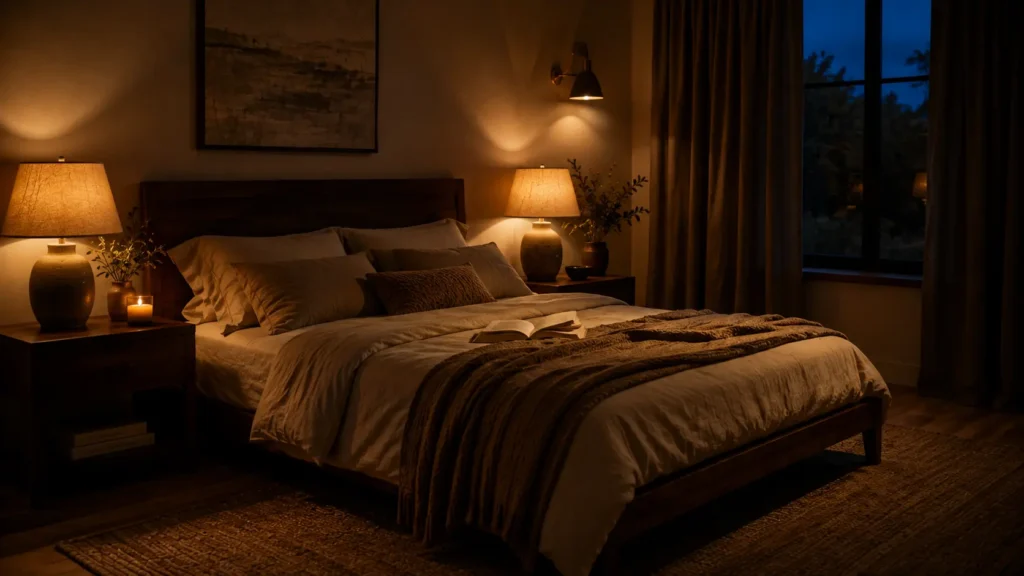
A bedroom lives two lives. It is a bright, practical room at eight in the morning and a soft, enclosed one at ten at night, and the second version is the one most people actually care about. A night warm aesthetic cozy bedroom is designed for that second life first.
After dark, the room loses its largest light source,the window — and gains a large dark rectangle in its place. Everything you do at night is about replacing that lost light with several small warm ones and keeping the darkness soft rather than stark.
The Three-Level Nighttime Lighting Plan
- Low level, under 60cm: candles, a small lamp on a low shelf, fairy lights behind the headboard. This is the layer that creates atmosphere.
- Mid level, 90 to 140cm: bedside lamps and sconces. This is the layer you read and talk by.
- High level, above 180cm: a dimmed floor lamp or a shaded pendant, kept low. This stops the ceiling disappearing into a black void.
Dimmers, Switches and Reachability
A dimmer is the cheapest luxury in a bedroom. Even a plug-in inline dimmer on a single lamp changes how the room feels at eleven at night. Smart bulbs are worth it here for one reason above all others: you can drop the whole room to twenty per cent without getting out of bed.
Check that every light you actually use at night can be turned off from where you sleep. Having to cross a dark room to hit a switch is the sort of small friction that quietly ruins an otherwise beautiful setup.
Textiles, Darker Accents and Window Treatments
Darkness reads as heavy when it lands on hard surfaces and cosy when it lands on soft ones. Adding a wool throw, a heavier rug or a fabric headboard changes how the room absorbs light at night far more than adding another lamp would.
This is also where deeper accent colours earn their place. A chocolate, forest or aubergine cushion that looks almost too dark at midday becomes rich and enveloping under 2200K light. I often add one deliberately dark element to an otherwise pale room purely for how it behaves after sunset.
For windows, layer two treatments: a sheer or light linen curtain for the day and a lined or blackout panel for the night. Hang both wide enough to clear the glass when open, so daylight is never blocked. Full-length curtains that puddle slightly absorb sound and make the room feel sealed in the best way.
Building a Calm Wind-Down Atmosphere
- Set one lamp as your evening anchor — the light that goes on first and comes off last.
- Keep a candle or diffuser on a tray, not loose on a surface. A tray turns a group of objects into a deliberate arrangement.
- Clear the nightstand of anything that charges, blinks or beeps. Blue standby LEDs undo warm lighting instantly.
- Fold the throw back rather than removing it. A partially turned bed is more inviting than a perfectly made one.
- Give yourself one soft surface for feet — a sheepskin, small rug or runner beside the bed.
20 Best Warm Aesthetic Cozy Bedroom
| # | Element | Description |
|---|---|---|
| 1 | Warm neutral walls | Beige, cream, or terracotta tones for a soft base |
| 2 | Layered bedding | Chunky knit throws, fleece blankets, and soft duvets stacked together |
| 3 | Fairy lights / string lights | Warm white LED strings around bed frame or wall |
| 4 | Candles (real or LED) | Soft flickering glow, vanilla or amber scents |
| 5 | Rattan or wicker accents | Baskets, lamp shades, or headboards for natural texture |
| 6 | Soft area rug | Shaggy or plush rug in warm tones underfoot |
| 7 | Wooden furniture | Oak, walnut, or reclaimed wood nightstands and frames |
| 8 | Linen curtains | Flowy, natural fabric that softens light |
| 9 | Warm-toned lighting | Amber or soft yellow bulbs instead of cool white |
| 10 | Reading nook corner | Cozy chair with a small lamp and throw blanket |
| 11 | Botanical accents | Dried pampas grass, eucalyptus, or small potted plants |
| 12 | Wall tapestries | Macrame or textile hangings for texture |
| 13 | Velvet or corduroy cushions | Soft, tactile throw pillows in warm shades |
| 14 | Gallery wall of photos/art | Warm-toned frames with personal or nature photos |
| 15 | Faux fur throw | Draped over bed or chair for extra coziness |
| 16 | Mood board / vision board | Personal touch pinned near desk or wall |
| 17 | Scented diffuser | Continuous warm, cozy fragrance in the room |
| 18 | Canopy or draped fabric over bed | Soft fabric drape for a dreamy, enclosed feel |
| 19 | Vintage or thrifted decor pieces | Mismatched lamps, frames, or trinkets for character |
| 20 | Soft blackout curtains | Dark warm tones (rust, olive, chocolate) for a snug feel |
Earthy Bedroom Warm Aesthetic Cozy Bedroom Styling
An earthy bedroom borrows its palette from landscape rather than paint charts — clay, sand, bark, moss, stone and sun-bleached grass. The reason it feels so restful is that these colours already sit together in nature, so your eye accepts the combination without effort.
Done badly, though, earthy tips into heavy. Too much dark timber, too many rough weaves and a saturated clay wall can make a room feel like a cave by four in the afternoon. The fix is structural rather than decorative.
Building the Earth-Tone Palette
Work with three earth families and let one dominate. A workable formula: sixty per cent light base (cream, sand, oatmeal), thirty per cent mid-tone (camel, terracotta, olive), ten per cent deep (chocolate, charcoal, forest).
Keep everything in the same level of saturation. Chalky, dusty, slightly greyed versions of each colour will always sit together more comfortably than one bright rust among a room of muted tones.
Natural Materials That Carry the Look
- Wood — oak, ash and mango for lightness; walnut and acacia for depth. Mixing two tones looks collected; matching a full suite looks like a catalogue.
- Stone and clay — a travertine lamp base, a stoneware jug, a rough ceramic bowl. These add weight without adding colour.
- Linen — the single most useful earthy textile, because its slubby, slightly crumpled surface catches light unevenly.
- Woven fibres — jute, seagrass, rattan and cane for rugs, pendant shades, baskets and headboards.
- Wool and undyed cotton — bouclé, chunky knits and hand-loomed throws in unbleached tones.
- Plants — olive, rubber plant, fiddle-leaf fig, pothos and snake plant all tolerate bedroom light and read as genuinely organic.
- Dried stems — pampas, bunny tails, eucalyptus and seed heads for structure without maintenance.
Keeping an Earthy Room From Feeling Visually Heavy
- Paint the ceiling and trim in a warm off-white, even if the walls are clay or olive.
- Choose furniture with visible legs so the floor runs underneath it. Solid plinth bases make small rooms feel packed.
- Limit rough textures to three or four pieces. Jute rug, rattan pendant, linen bedding and a woven basket is plenty; adding a seagrass wall hanging and a cane headboard on top is where it tips over.
- Introduce one smooth or reflective element — a mirror, a glazed ceramic, an aged brass lamp — to catch light and break up the matte surfaces.
- Keep some negative space. An earthy room needs empty wall and empty surface to read as calm rather than crowded.
Choosing and Layering Cozy Bedding h
The Layers, in Order
- Fitted sheet and pillowcases in washed cotton or linen — the base you actually feel.
- A flat sheet or light cotton blanket for temperature control across seasons.
- The main layer: a duvet for loft and softness, or a quilt for a flatter, more tailored line.
- A folded throw across the lower third of the bed, ideally in a texture the rest of the bed does not have.
- Pillows: sleeping pillows, then two Euro squares against the headboard, then one or two accents. Stop there.
Making Inexpensive Bedding Look Expensive
- Buy one size up on the duvet so it drapes past the mattress rather than sitting on top of it. This single change makes a budget set look considered.
- Wash and tumble linen before styling. The crumple is the point.
- Choose undyed, off-white or oatmeal over bright white — cheap white fabric shows its cheapness under warm light.
- Add one genuinely good piece: a wool throw or a linen pillowcase set. Quality in one visible layer lifts everything around it.
- Iron nothing. Warm bedrooms are meant to look lived in, not pressed.
Cozy Bedroom Texture Guide
| Material | Look and Feel | Best Used As | Warmth Level | Practical Note |
|---|---|---|---|---|
| Linen | Slubby, matte, softly crumpled | Bedding, curtains, cushion covers | Medium | Softens with every wash; never iron it |
| Cotton | Smooth, breathable, crisp | Sheets, quilts, lightweight blankets | Medium | Choose washed or brushed for softness |
| Velvet | Dense pile with a light sheen | Cushions, headboards, benches | High | Use in small doses; it dominates a room |
| Wool | Warm, springy, slightly rough | Throws, rugs, blankets | Very high | The fastest way to warm up a bed visually |
| Bouclé | Nubby, looped, sculptural | Accent chairs, ottomans, cushions | High | Best on one statement piece only |
| Knitted | Chunky, handmade, open weave | Throws, poufs, cushion covers | High | Adds instant handcrafted warmth |
| Woven fibres | Coarse, natural, organic | Rugs, baskets, pendant shades | Medium | Balances soft textiles; keeps rooms grounded |
Natural Materials and Furniture That Add Warmth
- Wooden Bedroom Furniture
- Upholstered Headboards, Benches and Accent Chairs
- Rugs, Curtains and Soft Flooring
Bedroom Wall Decor and Personal Details
Artwork, Mirrors and Gallery Walls
- Hang art lower than instinct suggests — centre at roughly 145cm, or lower if it sits above furniture, so it relates to the piece below it.
- Above a bed, choose one large piece rather than several small ones. Scale creates calm.
- Place a mirror where it reflects a window or a lamp, never where it reflects a doorway or clutter.
- For a gallery wall, keep frames in two finishes maximum and lay the arrangement out on the floor first.
- Textile art, a hung quilt or a woven piece adds sound absorption that framed glass cannot.
Plants, Dried Flowers and Natural Accessories
Bedroom plants do quiet work: they add an organic silhouette and a colour your eye reads as alive. Snake plants, pothos, ZZ plants and rubber plants all cope with the low, indirect light most bedrooms offer.
If light is genuinely poor, dried stems are a legitimate answer rather than a compromise. Eucalyptus, wheat, bunny tails and seed heads in a heavy ceramic vase give the same organic line with none of the maintenance.
Books, Ceramics and Personal Objects
The final layer is the one that makes a room feel inhabited. A stack of books you have actually read, a ceramic dish from a market, a framed photograph, a bowl of matches beside a candle.Group these in odd numbers and vary the heights — something tall, something low, something round. Three objects on a tray look styled; eight objects spread evenly across a dresser look like a queue.
Building a Cosy Reading Corner
A reading nook needs four things and no more: a comfortable chair, a light source over your shoulder, a surface for a cup, and something soft underfoot or across your lap.
Angle the chair slightly toward the room rather than pushing it flat against the wall, and use a floor lamp behind it rather than a table lamp beside it. In a small bedroom, a wide armchair in the corner opposite the bed adds far more perceived comfort than another chest of drawers.
Budget Decorating Guide
| Budget Level | Spend It On | Realistic Result | Biggest Single Win |
|---|---|---|---|
| Under $100 | Warm bulbs, one lamp, a wool throw, a candle | The room feels dramatically warmer at night | Replacing every bulb with 2700K |
| $100–$300 | Add curtains, a runner rug, cushion covers, plants | A coherent warm scheme with real texture | Full-length lined curtains |
| $300–$700 | Add a proper area rug, a second lamp, quality bedding | A finished, magazine-adjacent room | A rug large enough to sit under the bed |
| $700–$1,500 | Add an upholstered headboard and one timber piece | Enveloping, layered, clearly designed | The headboard |
| $1,500+ | Wall treatment, custom curtains, sconces, art | A fully resolved, high-end cozy bedroom | Hardwired dimmable sconces |
Seasonal Styling and Warm Bedroom Trends for 2026 it.
- Chocolate and espresso brown replacing grey as the default grounding neutral.
- Plaster and limewash wall finishes, valued for the way they hold light unevenly.
- Curved and organic furniture silhouettes — rounded headboards, soft-edged nightstands.
- Deliberately imperfect materials: visible grain, slubby weaves, hand-thrown ceramics.
- Lighting treated as furniture, with sculptural table lamps as the room’s focal objects.
- Fewer, larger pieces. The pared-back maximalism of layering three rugs is quietly retreating.
Practical Expert Tips From Ten Years of Styling Bedrooms
- Make a room cosier without buying furniture by changing bulbs, adding one throw, moving the bed to face the door, and clearing every hard surface except one styled tray.
- Layer light in threes. If you can only see one light source from where you sleep, add another at a different height before you buy anything decorative.
- Combine warm colours by keeping saturation consistent. Three chalky tones will always sit together; one bright tone among muted ones will not.
- Stop a dark room from feeling gloomy by lighting the corners rather than the centre, and by keeping the ceiling two shades lighter than the walls.
- Use texture instead of decoration. A wool throw and a linen curtain add more warmth than a shelf of ornaments and take up no visual space.
Common Cozy Bedroom Decorating Mistakes and How to Fix Them
- Color and Palette Mistakes
- Lighting Mistakes
- Bed, Furniture and Layout Mistakes
- Texture and Styling Mistakes
Final Words
A warm aesthetic cozy bedroom is built, not bought. Lighting sets the temperature of the room, colour sets its mood, texture gives it depth, natural materials give it soul, and personal objects give it the one quality that no shop can supply.i f you take nothing else from this guide, take the order: fix the light, then the textiles, then the colour, then the details. That sequence is why some rooms come together for a few hundred pounds while others swallow thousands and still feel like a display.
Style it for the version of the room you use most. For most of us that is the night warm aesthetic cozy bedroom — low lamps, a heavy throw folded back, a book, a candle, everything else quiet. Get that hour right and the rest of the day takes care of itself. Start this week with something small. Change four bulbs. Hang the curtains higher. Add one wool throw. Then stand in the doorway, take a photo, and let the room tell you what it needs next.
FAQs
How do I make my bedroom feel cozy if it has cold, hard flooring and white walls?
Start with textiles rather than paint, because soft surfaces are what change how a hard room feels. Add a large wool or wool-blend rug that extends well past the sides of the bed, floor-length lined curtains, and a bed layered with linen and a chunky throw. Then swap every bulb to 2700K warm white and add a lamp at bedside height. White walls look completely different under warm light, and many people find they no longer want to repaint at all.
Which paint color is best for a warm cozy bedroom that gets very little natural light?
Choose a warm neutral with a strong yellow or red undertone rather than a pale grey, which will turn flat and blue in low light. Creams, sands, warm off-whites and soft camels all hold their warmth indoors, and deeper choices such as clay or caramel can work beautifully because a dark room lit well feels intentional rather than gloomy. Always test a large painted board in the actual room across morning, afternoon and lamp-lit evening before committing.
How many light sources does a bedroom actually need to feel warm at night?
Three is the practical minimum, positioned at different heights so the light scatters rather than flooding from above. Aim for one low source such as a candle or fairy lights, one mid source at bedside height, and one taller source like a dimmed floor lamp to keep the ceiling from disappearing. Put as many as possible on dimmers, and make sure the light you use last at night can be switched off without leaving the bed.
Can a warm cozy bedroom still look modern and uncluttered?
Absolutely, and it is often the most successful version of the look. The trick is to deliver warmth through material and light rather than through quantity — pale timber, linen, plaster-finish walls, one sculptural lamp and a single large artwork. Keep the palette to two or three close tones, choose fewer and larger pieces, and let empty surfaces stay empty so the textures you have chosen are the thing your eye notices.